

Cartier
CT0472S
Eye size 51 millimeters, bridge 21 millimeters, temple 140 millimeters
$1,195
Fit guide
A Cartier glasses size is the three numbers printed inside the temple: eye size, bridge and temple length, in millimetres. So the CT0344O 003, listed at 56-19-145, has a 56mm lens, a 19mm bridge and a 145mm arm. Match a pair that already fits you to within 2mm on eye size and bridge. The Cartier frames in stock today run from 51mm to 64mm across the eye. This guide reads the model number, sorts the models into Cartier's lines, from C Décor to Santos, Panthère and Première, and sizes each frame to a face.

Eight questions bring most people to this page. Here are the short answers. The rest of the guide explains them.
Every Cartier frame here carries a code like CT0344O 003. CT is the brand prefix. The four digits are the model. The letter after them is the type. O is optical, a frame for prescription lenses. S is sun. SA is also sun; the CT0506SA and the CT0471SA are both acetate.
The three digits after the space are the colour. One model can come in several. The CT0554O is listed here as 001, Gold, and as 002, Silver. Same 56-18-145 frame, different finish. When you compare prices elsewhere, match the colour code as well as the model, or you are comparing two different frames.
Three numbers describe a frame: eye size, bridge, temple. Eye size is the width of one lens. Bridge is the gap between the lenses. Temple is the arm. Doubling the eye size and adding the bridge gives the lenses plus bridge, the figure in the size chart below, and the quickest way to compare one frame with another.
That figure is not the full width of the frame. The front, hinge to hinge, is wider by its end pieces, and some shops list that wider number as frame width. To compare like with like, do the same sum with the numbers inside your own frame; do not measure across the hinges.
The Cartier frames in stock run from 51mm to 64mm across the eye. The narrow end is the CT0052O (51-18-140), CT0472S (51-21-140) and CT0567O (51-19-140). The wide end is the CT0358S (64-13-145). In lenses plus bridge they run from 120mm to 141mm.
As a rough guide, a frame near 120mm in lenses plus bridge suits a narrow face, one near 130mm an average face, and one near 140mm a wide face, or a face that wants a sunglass to wrap a little. The numbers on a pair that fits you are the better guide. They are printed inside one temple. Find the same numbers in the tables below, and stay within 2mm on eye size and bridge.
Two cautions. First, eye size alone can mislead. The CT0092O (52-19-140) and the CT0056O (52-16-135) share an eye size but differ by 3mm in lenses plus bridge, because their bridges differ. Second, bridge width is not just about fit across the front. A 16mm or 17mm bridge sits closer to the nose than a 20mm or 21mm one. On a fine nose the narrow bridge holds. On a broad one the frame rides high. The bridge column matters as much as the eye size.
The store's frame size guide covers the general method. This page applies it to Cartier.
Swipe for the full table
| Eye size | Eyeglasses | Sunglasses | Fit |
|---|---|---|---|
| 51 | CT0052O, CT0567O | CT0472S | Average |
| 52 | CT0092O, CT0056O, CT0058O, CT0496O | – | Average |
| 53 | CT0049O, CT0290O, CT0593O | – | Wide |
| 54 | CT0291O | CT0471SA, CT0434S | Wide |
| 55 | CT0578O | CT0506SA | Wide |
| 56 | CT0286O, CT0344O, CT0554O | CT0582S, CT0474S, CT0465S | Wide |
| 57 | CT0417O, CT0410O, CT0492O, CT0120O | CT0579S, CT0330S | Wide |
| 58 | – | CT0466S | Wide |
| 62 | – | CT0398S | Wide |
| 64 | – | CT0358S | Wide |
Cartier sunglasses in stock run from 51mm across the eye, the CT0472S (51-21-140), to 64mm, the CT0358S (64-13-145). The eyeglasses stop at 57mm, so the widest fronts here are sunglasses.
Depth varies as much as width. The deepest sunglass lens in stock is on the CT0434S (54-23-135), at 48mm. The shallowest is on the CT0465S (56-18-145), at 33mm. A deep lens covers more of the face and shades more from the side.
Read a sunglass size the same way as an optical one: eye size, bridge, temple, and lenses plus bridge against a pair that fits you. Cartier sunglasses come with their own tinted lenses. Whether one can be reglazed to your prescription is a question for the optician before you order.
Frames in this chapter
Cartier
$1,195

Cartier
$945
Swipe for the full table
| Frame | Eye | Bridge | Temple | Lens height | Lenses + bridge |
|---|---|---|---|---|---|
| 51 | 21 | 140 | 36 | 123 | |
| 51 | 18 | 140 | 32 | 120 | |
| 51 | 19 | 140 | 43 | 121 | |
| 52 | 19 | 140 | 28 | 123 | |
| 52 | 16 | 135 | 30 | 120 | |
| 52 | 18 | 130 | 32 | 122 | |
| 52 | 21 | 145 | 43 | 125 | |
| 53 | 18 | 140 | 33 | 124 | |
| 53 | 19 | 145 | 38 | 125 | |
| 53 | 20 | 140 | 50 | 126 | |
| 54 | 17 | 145 | 47 | 125 | |
| 54 | 23 | 135 | 48 | 131 | |
| 54 | 18 | 145 | 38 | 126 | |
| 55 | 17 | 145 | 36 | 127 | |
| 55 | 20 | 140 | 46 | 130 | |
| 56 | 17 | 145 | 38 | 129 | |
| 56 | 19 | 145 | 39 | 131 | |
| 56 | 18 | 140 | 34 | 130 | |
| 56 | 19 | 145 | 33 | 131 | |
| 56 | 18 | 145 | 33 | 130 | |
| 56 | 18 | 145 | 37 | 130 | |
| 56 | 18 | 145 | 37 | 130 | |
| 57 | 16 | 140 | 52 | 130 | |
| 57 | 20 | 145 | 37 | 134 | |
| 57 | 16 | 140 | 52 | 130 | |
| 57 | 19 | 145 | 40 | 133 | |
| 57 | 18 | 140 | 40 | 132 | |
| 57 | 17 | 140 | 40 | 131 | |
| 58 | 16 | 145 | 44 | 132 | |
| 62 | 16 | 140 | 140 | ||
| 64 | 13 | 145 | 36 | 141 |
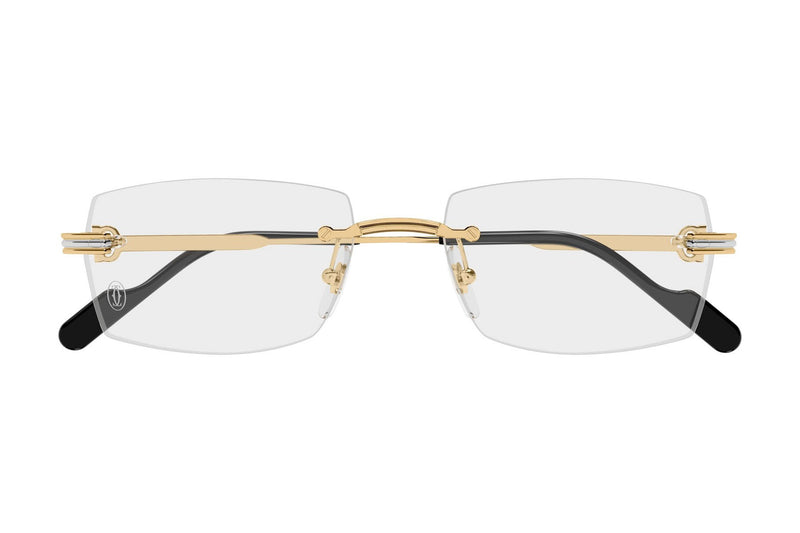
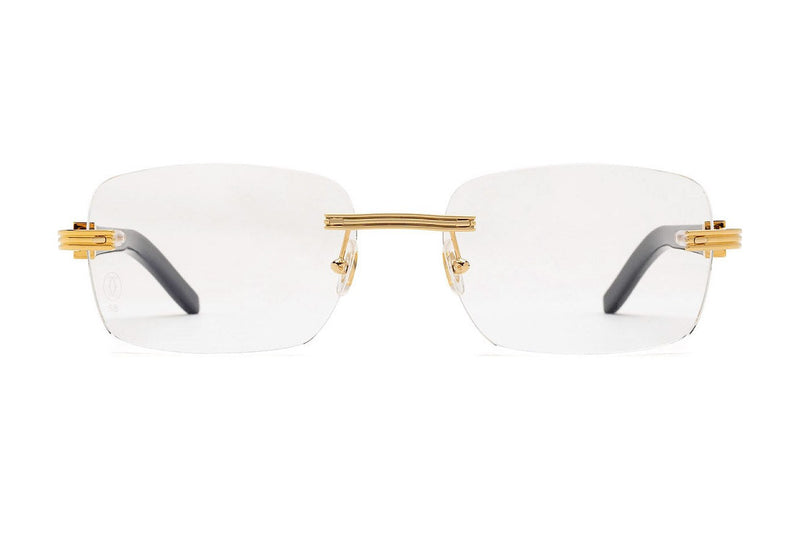
Cartier's site sorts its eyewear into lines, and each line carries its own motif. The model code does not say which line a frame belongs to; the motif does, and it sits in one of a few places: the hinge, where the temple meets the front; the temple itself; or the front and bridge. Cartier's site does not print model codes, so the line given for each code below is the one used by the retailers who list the same code, checked against the motif on the frame.
Some details do not settle the line. A small Double C on the nose pads appears on frames from C Décor, Panthère and Santos alike. Horn and wood temples turn up in C Décor and in Première; buffalo horn frames are often called Buffs, and the Cartier horn and wood page gathers the ones we have. Rimless fronts run across C Décor, Panthère, Première and Double C in this guide; the rimless glasses page gathers every rimless frame we have, Cartier or not. Retailers' nicknames, such as Piccadilly for the CT0092O, are shop names, not Cartier lines.
On the brand's site the Santos de Cartier eyewear is described as sunglasses that pay homage to the iconic Santos de Cartier watch through its signature motif, the screw. The brand's site shows the line in metal and titanium, in golden, platinum and black finishes, and lists a rimless gold rectangle at 56-20-145.
The other squared metal fronts in this guide are C Décor or Première, so a squared gold front alone does not make a frame Santos: look for the screw.
For fit, the wider squared metal fronts run from 55 to 57mm here, whatever the line. The Première CT0578O (55-17-145, 127mm in lenses plus bridge) is the narrowest. The C Décor CT0344O (56-19-145), the Santos CT0554O (56-18-145) and the Première CT0286O (56-17-145) all sit near 130mm in lenses plus bridge. The CT0344O, at 131mm in lenses plus bridge, is the widest optical rectangle in this guide. In sunglasses the same shape comes in C Décor as the CT0465S (56-18-145), the CT0582S (56-19-145) and the CT0579S (57-19-145).
All of these rectangles have 145mm temples. That is a long arm. It suits a larger head and gives room to bend the tip behind the ear. On a small head the tip will overhang, and an optician will need to shorten the bend.
Now the narrow bridge. A 56mm eye with a 17mm bridge, as on the CT0286O, puts the lenses close together and the nose pads close to the face. On a narrow nose this is what holds the frame up. On a wider nose the pads sit high and the frame lifts, so the lenses tilt and the top rim crowds the brow. If your nose is broad, choose the 19mm bridge on the CT0344O over the 17mm on the CT0286O, even though the eye size is the same.
Frames in this chapter
Cartier
$1,395
Cartier
$3,595
Cartier
$1,395
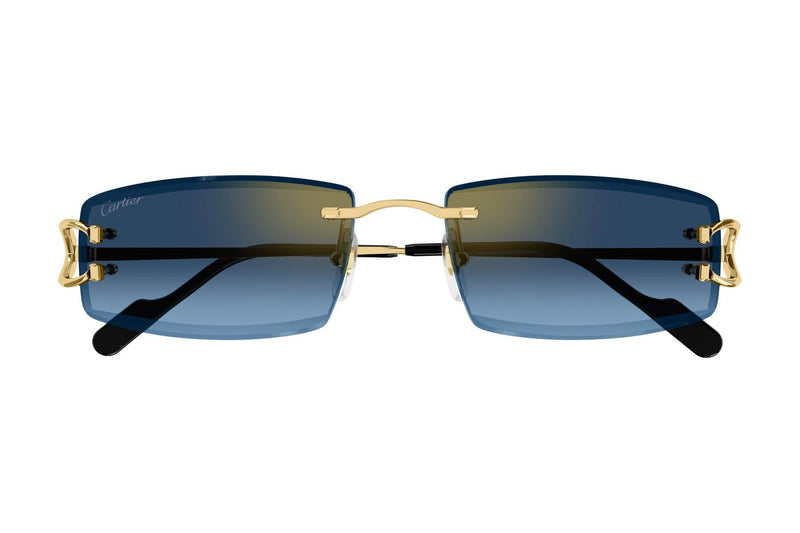
The brand's site describes the Panthère de Cartier eyewear as sunglasses with personality that celebrate the untamable elegance of the panther, and calls the line the heir to its iconic feline. The panther is the brand's emblem, and on this line the frame carries it. The brand's site shows the line in smooth golden and platinum metal, in black acetate, and in composite with metal. It also shows rimless fronts, including a rimless gold rectangle at 56-18-145.
On the frame the panther takes several forms, from a pouncing panther along the temple to a faceted head at the hinge; the chapter on Cartier's lines sets them out. Panthère models with rimless gold fronts include the CT0058O rectangle, the CT0120O cat-eye and the CT0398S and CT0474S sunglasses.
The rimless question matters more than the emblem. A rimless frame has no rim around the lens. The lens is drilled and the bridge and temples bolt to it. That makes the frame light, and it makes the lens do the structural work. A strong prescription is thick at the edge for minus, or thick in the centre for plus. Rimless shows that thickness plainly, and a thick, heavy lens strains the drill points. A light prescription in a rimless frame looks like nothing at all. A strong one looks like glass on a wire.
Rimless is not only a Panthère feature. Among the gold rectangles, the C Décor CT0092O, CT0344O and CT0290O and the Première CT0286O and CT0578O are rimless too, as is the Double C CT0593O. The rimless glasses page gathers every rimless frame we have, from Cartier and other brands. Several have shallow lenses: the CT0092O is 28mm deep, the CT0058O and the CT0052O 32mm, the CT0344O 33mm. Single vision lenses rarely mind that. A progressive needs more depth, and your optician confirms what will work from your measurements. The lens guide explains lens materials and what a strong prescription needs from a frame. Rimless and shallow lenses in practice, further down, covers the depth problem.
A Cartier listing here records one of three materials: metal, acetate, or acetate and metal together, which some listings still call combination. Each behaves differently on the face. The field does not record horn or wood temples, which the end of this chapter covers.
Metal is the lightest on the nose, because the weight sits in the lenses rather than the front. It carries nose pads on arms, which an optician can bend to raise, lower or widen the fit. That is the main reason to choose metal if your nose is unusual, or if two people in your family have different noses and share a face width. Colours include Gold, Silver, Gold / Platinum, Gold / Havana and Gold / Black.
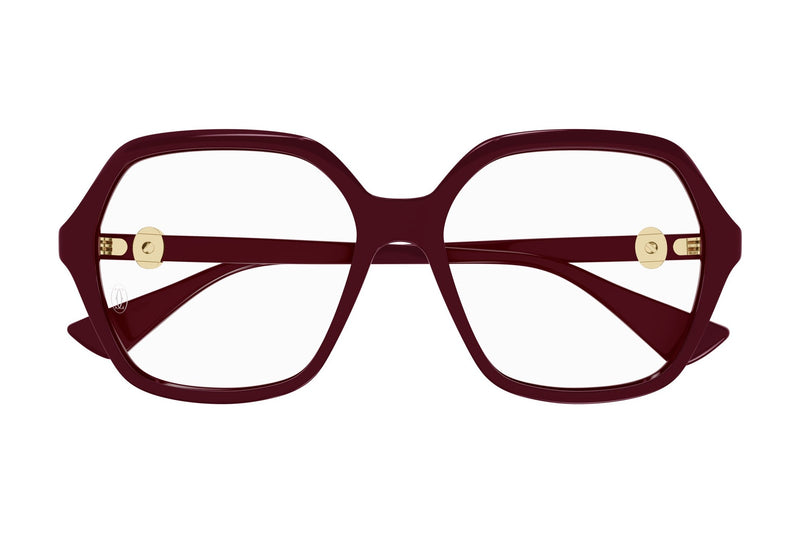
Acetate has a bridge shaped into the front, with no pads. It fits or it does not, and what an optician can do is warm the front and adjust the temples. It is heavier than metal and warmer to the touch. The acetate frames sit at the lower end of the price list; the CT0291O (54-18-145, 126mm in lenses plus bridge) and the CT0472S are two of them. Colours include Havana, Dark Havana, Burgundy, Black / Grey and White / Grey. The CT0434S (54-23-135) has the widest bridge in this guide, 23mm, on a 135mm temple, which is an unusual pairing for a broad nose on a small head.
Acetate and metal covers the CT0496O round (52-21-145, 125mm in lenses plus bridge), the CT0056O oval and the CT0579S sunglass, and the split differs. The CT0496O, a Première browline, has an acetate brow over a gold-finish metal front. The CT0056O and the CT0579S are C Décor and rimless: metal at the front and hinge, acetate in the temples, marbled white on the CT0056O and black on the CT0579S. Check the photographs before you assume where an optician can adjust the fit.
Some gold rimless frames have temples of buffalo horn or wood, though the listing records the material only as metal. The CT0052O, Gold / Red Wood, is C Décor, not Première, and its temples are red laminated wood; the brand's description of the model says each temple is ten thin layers of wood pressed together. The CT0582S sunglass, Gold / Burgundy / Red, is C Décor with wood temples in two tones. The CT0049O (C Décor) and the CT0286O (Première), both listed as Gold / Black, have black buffalo horn temples, and the brand's own copy says each horn frame differs in depth and tone. The Cartier horn and wood page gathers these frames.
Frames in this chapter

Cartier
$595
Cartier
$1,195
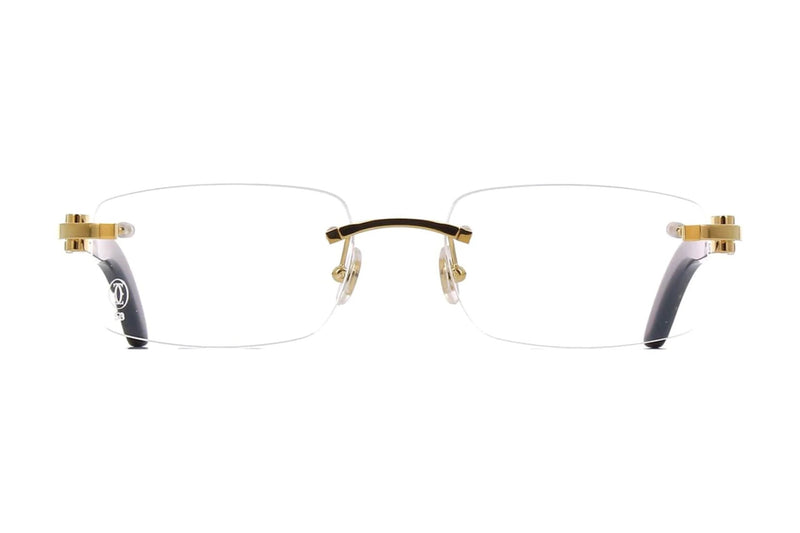
Lens height is the depth of the lens top to bottom. The Cartier frames in stock run from 28mm to 52mm where the listing records it. The shallow ones in this guide, all rimless, are the CT0092O at 28mm, the CT0056O at 30mm, the CT0058O and the CT0052O at 32mm, and the CT0344O, the CT0049O and the CT0465S at 33mm.
Single vision does not care about depth. A progressive does. A progressive lens has a distance zone at the top, a reading zone at the bottom and a corridor between them. Your pupil sits in the distance zone, and the reading zone needs room below it. A short-corridor design wants about 14mm from pupil to the lower edge. A comfortable one wants 17mm or 18mm. On a 28mm lens the pupil sits near the middle, which leaves about 14mm below it. That is the minimum, with no margin for a frame that sits a touch high. On a 33mm lens there is room. On a 40mm lens there is plenty.
So on the CT0344O and the CT0049O, at 33mm, a progressive is usually possible with a careful fitting. On the CT0092O, at 28mm, single vision is the easier choice, and a short-corridor progressive is possible only if the measurements allow, fitted by someone who measures rather than guesses. Either way, your optician confirms suitability with your measurements before any lens is cut. If your prescription is strong and you want a progressive, choose from the deeper frames, and choose a rim over rimless.
When is an optician likely to advise against a frame? A rimless front with a high minus prescription, because the edge thickness shows and the drill points carry the load. A prism, in any shallow lens, because prism adds thickness where there is no depth to hide it. The first applies to every rimless frame here, whichever line it comes from; the deeper rimless ones, such as the CT0593O at 50mm, the CT0466S at 44mm and the CT0120O at 40mm, give a stronger prescription more room. The second applies to any shallow lens.
Frames in this chapter
Cartier
$3,595
Cartier
$695

Cartier
$1,295
Material, first. The Cartier frames in stock fall into three groups by what they are made of, and each group sits higher on the price list than the one before, though neighbouring groups overlap at the edge. Every listing gives its own price.
On the horn frames the listing records the material only as metal and the colour as Gold / Black. The black is buffalo horn, not acetate: the material the listing leaves out. Horn and wood also ask more of you. Cartier's care advice keeps water and detergents off horn, and water, greasy substances, make-up and cleaning products off wood, and tells you to keep glasses in their case, away from heat.
Beyond the frames we stock, the brand's site shows precious pieces, such as a pair of Panthère de Cartier sunglasses in rose gold with tsavorite garnets. The Cartier horn and wood page gathers the horn and wood frames we have.
The surest way to choose between a 52 and a 56 is to put both on. Eye See Optique has two shops, in Arlington and Dumfries, Virginia. The visit page has the addresses and directions. Bring your current glasses so the numbers can be compared, and bring your prescription if you have it.
If you order online, the frame ships as a frame, without prescription lenses. Shipping within the United States is free, insured and signed for. Your own optician fits the lenses. If you are local, the Eye Rx practice can fit them. Either way, the person cutting the lenses will want to see the frame on your face to take the fitting heights, which is the measurement the chapter on shallow lenses turns on.
Returns are accepted within seven days of delivery, with a 15% restocking fee. That window is meant for a frame that does not fit, so try it on the day it arrives. Once lenses have been cut for a frame, it is yours.
The size chart above lists every Cartier frame in stock with its model, colour, size, lens height and lenses plus bridge, straight from the listings, and each listing gives the price. Use it with this guide. Where a number here and a number on a product page disagree, the product page is newer.
Inside one temple. Look for the model code and colour code, such as CT0344O 003, and the three size numbers: eye size, bridge and temple length, in millimetres. On the CT0344O those are 56, 19 and 145. Every listing here gives the same three numbers, so you can match a frame you own against the size chart.
CT is the brand prefix. The four digits are the model. O means optical, a frame for prescription lenses, and S means sunglasses. SA is a sunglass suffix as well; the CT0506SA and the CT0471SA are both acetate. The three digits after a space are the colour code. CT0554O 001 is Gold and CT0554O 002 is Silver, the same frame in two finishes.
In stock today, Cartier eyeglasses run from 51mm to 57mm across the eye, and Cartier sunglasses from 51mm to 64mm. Bridges run from 13mm to 23mm and temples from 130mm to 145mm. The sizes at a glance table on this page lists the frames at each eye size.
The CT0092O is 52-19-140, 123mm in lenses plus bridge, with a 28mm lens. The CT0344O is 56-19-145, 131mm in lenses plus bridge, with a 33mm lens. Both are gold C Décor rimless rectangles. The CT0344O is a full size wider, 5mm longer in the temple and 5mm deeper in the lens, which is the difference between a narrow face and an average one, and, for a progressive, between a tight fitting and a comfortable one.
The gold rimless optical frames in this guide come from four lines: C Décor (the CT0092O, CT0344O and CT0290O among them), Panthère (the CT0058O and the CT0120O cat-eye), Première (the CT0578O and CT0286O) and Double C (the CT0593O). The table on this page shows which are in stock now, with sizes and lens heights. The CT0092O (52-19-140) and the CT0058O (52-18-130) are the nearest to a classic rimless gold rectangle. Both have shallow lenses, 28mm and 32mm, so if you want a progressive, ask before you buy; your optician confirms suitability with your measurements. The rimless glasses page gathers every rimless frame we have.
Look at the frame itself. The brand's site says the Santos de Cartier eyewear takes its signature motif from the Santos watch, the screw: look for screw heads on the temples, and on some models the bridge. The Panthère de Cartier eyewear carries the brand's emblematic animal, the panther: a pouncing panther on the temple, a faceted panther head, or enamel spots. If you see neither, look for a C at the hinge (C Décor), a godron beside a C (Première) or an enamelled Double C medallion (Double C). The chapter Which Cartier line is which gives the line for each model code in this guide.
Yes. The smallest Cartier frames in stock are 51mm across the eye. The frames at 52mm or less, the sizes for a narrow face, are CT0052O (51-18-140), CT0472S (51-21-140), CT0567O (51-19-140), CT0056O (52-16-135), CT0058O (52-18-130), CT0092O (52-19-140) and CT0496O (52-21-145). Watch the bridge as well as the eye size: a narrow bridge sits closer to the nose, a wide one lower on a broad nose. The narrow frames page gathers small fronts from every brand.
The store ships frames without prescription lenses. Free, insured, signed-for shipping within the United States. Your own optician fits the lenses, or, if you are near Arlington or Dumfries, the Eye Rx practice can. Returns are accepted within seven days of delivery with a 15% restocking fee, so try the frame on the day it arrives, before any lenses are cut.


