Buying guide
Are designer glasses frames worth it? An optician's answer
Sometimes. The money in a good frame goes into material, hinges and finish, and into a frame that holds its adjustment and can be repaired. It does not buy sharper vision; that is the lenses. Here is what to look for, and when a cheaper frame will do.
The short answer
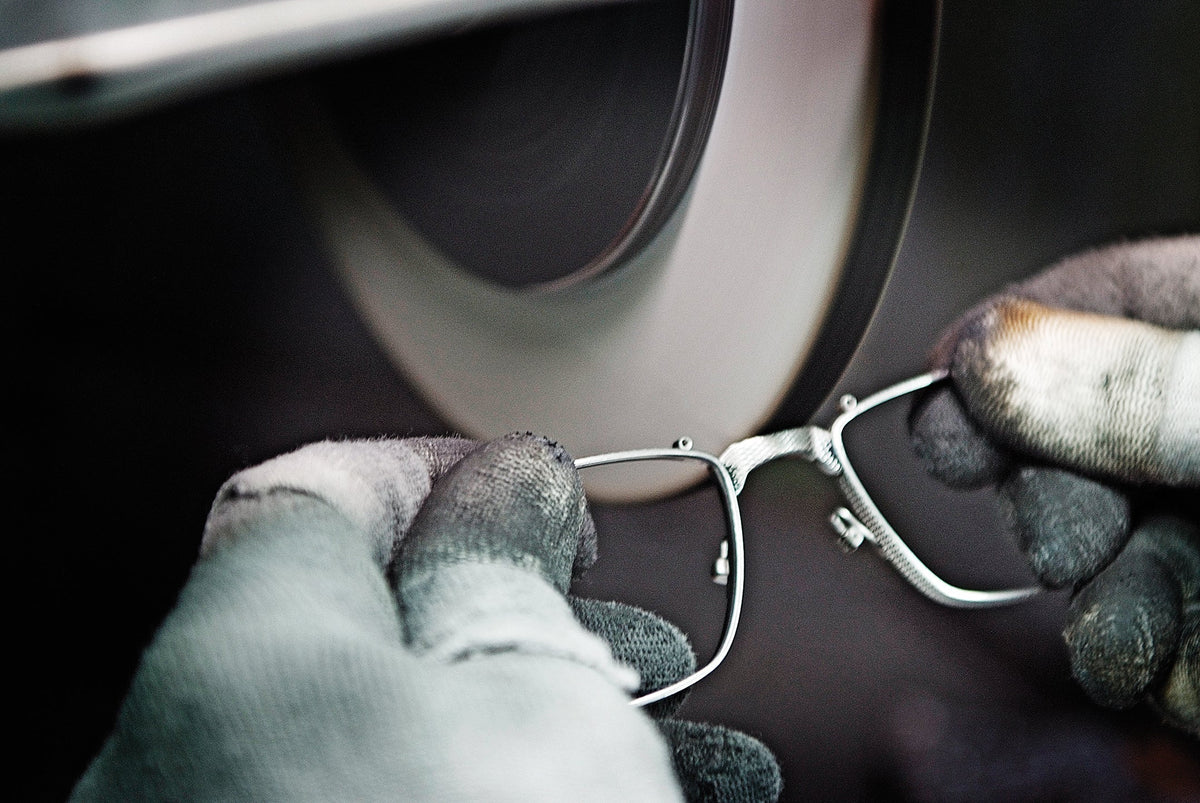
A designer frame is worth it when you wear it every day for years and the price has gone into things you can check: the material, the hinges, the finish, a fit that stays set, and parts behind it if something breaks. It is not worth it when the only difference is the name on the temple.
Price and quality do not line up neatly. When this guide was written, the frames we listed ran from $325 to $3,595, most of them between about $450 and $1,000, and Blackfin's titanium frames, made in Agordo in the Italian Dolomites, cost less than most of our acetate frames. Read the frame, not the price. Our DITA vs Oliver Peoples comparison sets two price bands side by side.
What the price pays for: material
Titanium. Light, strong and resistant to corrosion, so a titanium rim can be very fine and still hold a lens square. DITA's own site describes its beta-titanium, a titanium alloy, as light, durable and extremely flexible, and says it finishes every frame in Japan. The company behind Blackfin turned to titanium in 1991. Matsuda works in titanium, sterling silver and gold, by hand in Japanese workshops. See our metal frames and the frames made in Japan.
Acetate, finished by hand. Good acetate is cut from a coloured plate, then milled and polished, so the colour runs right through the material; many inexpensive frames are injection-moulded instead. Henau frames are made by hand in France, cut from rare and often strongly coloured acetate plates. For its frame-within-a-frame acetate designs, Blake Kuwahara mills the inner and outer parts separately in Japan, laminates them together in a process the brand puts at two months, then finishes them by hand. See our acetate frames.
Horn and wood. Cartier, the Paris jeweller, began making eyewear in 1983 and has cut frames in 18-carat gold, platinum and bubinga wood. When this guide was written, the Cartier rimless frames we listed that pair gold metal with wood or horn were priced at roughly two to three times our plain gold rimless Cartier frames. Horn and wood are natural materials, so no two pieces are quite alike, and they generally want more care with water and heat. See Cartier horn and wood.
Hinges, adjustment and repair
Hinges. The hinge moves every time you put the frame on, and it is where cheap frames tend to give out first. OVVO's patented hinge has no hinge screw to work loose. Piero Massaro won the Silmo d'Or for technological innovation in 2021 with a cylindrical hinge.
Adjustment. An optician sets a frame to your head: temples, tilt, the curve behind the ear, the pads. Acetate is warmed to adjust and tends to hold its set. Metal frames usually sit on nose pads on small arms that can be bent to raise, lower or level the frame. A frame that holds its adjustment keeps the lenses where the optician put them, in front of your pupils.
Repair. Screws and nose pads are standard parts. A temple, a front or a special hinge has to come from the brand, if it still supplies that model. Parts for a given model are not available for ever, and we cannot promise them, so if repair matters to you, ask before you buy.
What it does not buy
Sharper vision. That is the lenses: an up-to-date prescription, the lens design, and how accurately the optician centres each lens on your pupil and, for progressives, sets the fitting height. The same lenses, fitted equally well, see the same in a modest frame as in an expensive one.
Fit. A frame at the wrong width, or with a bridge that does not suit your nose, will slide, pinch or tilt whatever it cost, and a tilted frame moves the lenses off their centres.
When a cheaper frame is fine
- A spare pair, for the car, the gym or the bedside.
- Glasses that will have a hard life: sport, rough work, or a habit of losing them.
- A shape you want to try before committing to it.
The case for spending more is strongest for the pair you wear all day, every day. A well-made frame can often take new lenses when your prescription changes, once the optician fitting them confirms with your measurements that it suits, so its cost is spread across more than one prescription.
How to judge a frame in the hand
- Work the hinges. Even resistance, no wobble, no grinding.
- Set it upside down on a table, temples open. Both temples should touch. If one lifts, the frame is out of true.
- Run a finger round the edges. Acetate should be smooth at the rims, bridge and temple tips. On metal, look at the joins and the finish near the hinges.
- Look at the nose. Pads on arms can be set to your nose. A bridge shaped into an acetate front has to fit as it is.
- Read the inside of the temple. Model, colour code and the three size numbers are usually there. Check them against the listing.
Online you cannot do this first, which is why every listing here carries its measurements.
Fit over label
If a frame is the wrong size, nothing above makes it worth the money. Read the three numbers inside the temple of a pair you wear comfortably and add the two lens widths and the bridge; our frame size guide shows how. The narrow and wide frames pages gather the fronts at either end of the range.
We sell frames only, not prescription lenses. An optician fits the lenses, in our Arlington or Dumfries shops or your own, and confirms with your measurements that the frame suits your prescription; our lens guide covers what to bring. Shipping is free and insured within the US. Returns are accepted within seven days of delivery, less a 15% restocking fee, and sale frames are final sale.
Are designer glasses frames worth the money?
For a pair you wear every day for years, often yes, if the money has gone into material, hinges, finish and a frame that holds its adjustment and can be repaired. For a spare pair or a style you are only trying, a cheaper frame is usually fine. Get the size right first: a well-made frame at the wrong width is still the wrong frame.
Do expensive frames help you see better?
No. Vision comes from the lenses: the prescription, the lens design, and how accurately each lens is centred and fitted. The frame's part is to hold them in the right place, and a frame that keeps its adjustment does that for longer.
Is titanium worth paying more for than acetate?
It depends on what matters to you. Titanium is light, strong and resists corrosion, and often sits on adjustable nose pads. Acetate carries its colour in the material and holds its set, but an acetate front rests on its own bridge, so it has to fit your nose as it is. Titanium is not always dearer: when this guide was written, Blackfin's titanium frames cost less than most of the acetate we listed. Compare metal and acetate frames.
Can designer frames be repaired?
Often, depending on the part. Screws and nose pads are standard, and most opticians can replace them. A broken temple, front or special hinge needs a part from the brand, if it still supplies that model. OVVO says its screw-free hinge is a snap-fit that separates under extreme pressure, for easy repair. Ask about parts before you buy.